Sometimes life imitates satire, or something like that.
(Those who don't understand German may still understand the content. Basically, in the video one can see two men from the "Office to protect the constitution" who are asked about whether Nazi-terror exists. They say no, having asked Nazis whether it is true. Therefore the office of "right-wing terrorism" is closed and "real" terrorism is then combated: "left-wing terrorism" and "Islamic terrorism".)
Following the, *ahem* revelations about Nazi terror in Germany over the past ten years things are sensitive in Germany. Now's the time for considering how the role of the state in recent Nazi murders should be deal with, and how the media reports were racist, no?
No.
Kristina Schröder has chosen this moment to remind us where the real danger lies. (Original in German here). Yes, the socialist newspaper: "New Germany"!
Who else to accuse, but a Protestant Youth Pastor! Lothar König was one a float the the anti-Nazi demo and did the dangerous thing of playing a traditional left-wing song from the early 70's that has been sung on demos ever since then and has been accused by the Saxony police of inciting to a disturbance of the police. The song with lyrics (with things like "I've been wounded a thousand times, I've been hungered a thousand times. [...] Come brother, come sister, come mother, write the words "No power for anyone!") was considered to be "aggressive" with a potential towards inciting violence. (Original text here.)
Zeitbild Stiftung's (it has to be noted here that the foundation is sponsored by the German state: The Federal Ministry for Families, Seniors, Women and Youth) website also shows what they consider to be most dangerous. On the left one sees two links to sites about "extremist violence", both in fact being "left-wing extremism". One also sees one for "hinder violence, advocate integration"; what is meant there is that it is "Turkish children and youth are the biggest group among immigrants with a very high level of violence". Note also that this initiative is partly sponsored by the EU.
Excuse me one moment while I take a pause to express my reaction.
Note also that the board of the foundation contains someone from one of the main newspapers of Germany, the president of German marketing federation, someone from German industry and a tax adviser (i.e. all are men with white skin and people who, I would guess, know more about being in a powerful situation than a weaker one in society). Note also that the symbols considered to be "left-wing extremist" includes:
...as well as the anarchist symbol. It's like in GB where the police have decided that the Occupy movement are terrorists.
I am beginning to think that Hermann Gremliza is right: There is no "left-wing extremism" and there is no "right-wing extremism". There are Anarchists who defend themselves from violent people with weapon, there are a few pieces of graffiti on walls and, occasionally, attempts to defend themselves from Nazis (with no help from the police). There are Nazis who kill immigrants from Senegal and of course Turkey and Greece; who do pogroms against Vietnamese immigrants, who set fire to houses where Romany people live, who scream abuse against people with dark skin on a trains and attacking someone with dark skin on a bus, who spray tear gas into the face of someone of a different "race", set fire to mosques, attack (as politicians) peaceful protesters or the police with pavement stones (from 4:30).
Perhaps Gremliza is right in saying that the term "right-wing extremism" is in fact false as it implies a left-wing equivalent. Certainly, some left-wingers (and anarchists; not all anarchists are left-wing) do do violent things; largely against people with batons, tear gas, water canons, armour and shields; largely when attacked. Nazis, however, kill people and their potential victims are a big group.
Perhaps the Munich-based Zeitbild Stiftung should concentrate on the Bavarian police ("the guarantee for your security"). Note the statistics for police violence and how they are much higher than "left-wing acts of violence". Or perhaps they should look wider at police brutality in the rest of Germany. I daresay Amnesty International would agree with me.
Keep in touch, either on Facebook or via the RSS Feed on the top right corner. Soon (probably early next year) I shall write a series on "Taboos and other subjects to piss people off", which will be dead good, I quite humbly tell you.
I'd like you to do a little role-playing now. Imagine yourself to be a young lad or lass
You're not interested in politics., but you're happy that Poland regained its independence in 1918. You like living in Poland (your friends are Polish, you like Polish hip-hop, you've had many nice holidays in Zakopane and Sobot.) You're glad to be Polish.
Some friends of yours hard about a 'march of patriots' on Polish Independence Day and, as Poland will be playing Italy in Wrocław that evening, it sounds like a cool thing to do, to experience the mood before a game, to express that you're glad to be Polish. You arrive in Wrocław, and wow! So many people! These are people like you.
The march starts and people light flares, like at a football game. It's all so impressive. You feel good. We're all Poles together. You enjoy the football-type chants. This is a good thing. You walk along, and people are smiling, people are making noise, on this nice looking market square, packed together. This is Poland!
While walking away from the market square you see a small group.
Violent, up to no good, anti-free speech scum, apparently
They appear to be against us. People around you at shouting at them, so they must be against this parade. They're anti-Polish, people are shouting. They're not one of us. They're not real Poles. You are caught up with the group mood. Apparently they are the 'red gang'. That name rings a bell. They must be communists. They did bad things in Poland.
You see a flag with a man you don't recognise on it. "Who's he?", you ask your friend. "Roman Dmowski", is the answer. He was a "Polish patriot" who helped to make Poland exist. He wanted to protect Poland against their enemies, "Germans and the Jews".
You have already noticed a few flags with the letters 'NOP" written on them. You don't know who they are, but they must be cool. They organised this parade, you hear. You like this parade, so the NOP must be good people. They are pro-Poland and anti-those who are against Poland. Your grandmother had told you about those nasty gays, trying to destroy Poland on behalf of the EU. They're not like us.
You begin to feel more powerful as part of the group. God bless (Roman) Catholic Poland and the NOP!
The importance of a strong counter-voice
What I have tried to convey here is the process made possible by such marches. A march by fascists is not the danger per se. A Poland without marches by fascists would not mean a Poland without fascists. The thing is, a bit of awareness of group dynamic procedures (see Zimbardo) shows two outcomes that can occur after marches by fascists: While such inbetweeners may not be as radical as the NOP fascists, such a march strengthens their sense of being Polish, a sense with is exclusive. People of other religions, views: LGBT's and Jews implicitly do not fit into this Poland. This implicit sense can become more explicit over time, upon being exposed to more radical views. While the young people or other 'patriots' may not leave the parade as NOP members, they'll be more open to them as being a "good thing" and also more open to extreme views.
Secondly, the point of the fascists I imagine they felt more powerful after the march. They were so big, and the counter-demo was so little. Such a feeling of power can lead to an escalation of violence in their everyday life (attacks on people of different colours, graffiti on Jewish graveyards), as they feel that there is a small opposition to them.
That we, the counter-demo was so small (there were about 150 of us compared to 1,200 of them) shows that no credible alternative to right-wing extremism was demonstrated. For the inbetweeners such a parade can serve as a turning point. The counter-demo was so small and contained no-one they had heard of. No Priest. No politician.
Of course, there was the 'march for tolerance' on the Wednesday before (a good event that I attended), but I doubt if the fascists and inbetweeners read Gazeta Wyborcza, the newspaper which supported the event, an event which will certainly serve to maintain or increase group cohesion between those who are pro-tolerance; furthermore, the Israeli/Norwegian/Polish school exchange will help.
With a very small exception, those who support tolerance did not turn up to stand against intolerance. Instead, they left it to the anarchists. However, anarchists are not liked by the mainstream.
Prejudice against the 'far-left' and anarchists
Gazeta Wyborcza has reported that at there were 'gangs from both sides running after each other' (last year) and 'people on both sides were throwing fireworks at each other' (this year). Probably unlike the reader of this article, I was present at both events. Regarding last year the claim is totally untrue. I saw one scuffle between an antifa girl and a fascist over a flag. What was reported simply didn't happen. Regarding the throwing of the fireworks, well look at this video:
Torches of fire were thrown at us as soon as they came to us. These hit people. One girl found herself with small burning bits of paper on her head. I would estimate that about 25 lit torches were thrown at us, and two lit flares. Of them about four lit torches were thrown back. The words used by Gazeta Wyborcza are a misrepresentation of what happened. We were under a sustained attack. People on our side backed away from the police line to avoid being hit. Some went into the passage to escape the flames. We were under immense provocation (click on the video about, by the way, and see how in the comments how happy people were that we were being attacked in such a manner). That is the context in which to read that some lit torches were thrown back. The great majority of people on our side simply stamped the torches out. (Read also here for first-hand eyewitness accounts.)
This attack on us was simply described with the words "people on both sides were throwing fireworks at each other", thus creating the false impression of the same old story of the 'far-left and far-right being as bad as each other' (something I wrote about here). The Gazeta Wyborcza did also not help in their selection of photos shown, which showed no lit torch coming our way (I would put this down to a difficulty in producing such photos myself, or perhaps I am being naive).
I have also read the claim that all of those who protested against the 'patriots' were there to do violence. This is a spurious claim with no basis in reality. This is the usual anarcho-bashing. Please, if you are to comment on 'anarchist violence' do a bit of research first.
Another incident happened, by the way; one that I am not clear about. For some time hundreds of fascists didn't march, rather, in the midst of the thrown lit torches stood in front of the police shouting abuse at us. I then saw that some policemen were hitting some of the fascists. It seemed that either the fascists were attacking the police or that they were trying to get through the police to get to us. In any case, the police used tear gas, I thought to push the fascists back, but I also hear in order to 'separate the two sides'. In fact hardly any of us were right behind the police due to the aforementioned fire-attack. It is for this reason that most of us covered our faces with scarfs. Bear that in mind regarding the discussion about people hiding their faces. (A separate article will be written about the state's answer to the day's events.)
Fear
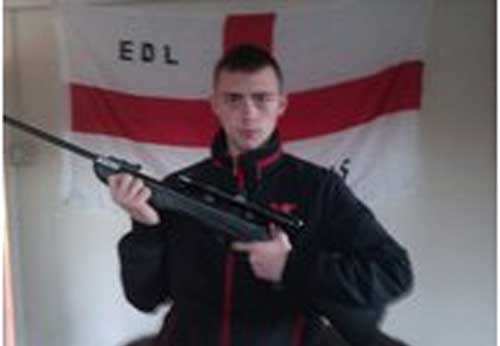
Bravado, alcohol, group dynamics were some of the reasons why we were attacked (furthermore, after the march we were to find ourselves surrounded by fascists by Hotel Monopol with the police protecting us on both sides). There's more to that, though. It was, consciously or unconsciously an attempt to scare us. This is a common fascist tactic: Recently the English Defense League sent a warning message to the Occupy LSX campers in GB. Plus we have Breivik, of course.
They wanted to discourage us from coming again next year and from using civil courage in any acts of violence we see in our daily lives. I know some who avoided coming due to the fear of violence. It is this fear that strengthens fascists. It's a (pardon the pun) vicious circle: They had a greater number, so they felt more powerful, so they attacked us (such an attack didn't happen last year when the numbers were more equal). Less people may attend next year as a result. I was with people who were at their first protest. They backed away from the missiles coming our way and I don't think they'll come to a protest again.
Those violent anarchists again, this time in Warsaw
If one wants a more tolerant Poland one has to do more than support tolerance (through marches, days of business, exchanges), one has to show courage by opposing intolerance in our daily lives, including during such marches. By backing off, by showing fear, by inaction, by staying at home, by complaining about those people who actually wish to let fascists know what they think fascists get stronger (and, read these words very closely:
Those at the counter-demo did not want to stop the fascists from speaking their opinions, rather, letting the fascists know about theirs.)
An alternative circle would be: More anti-fascists than fascists would mean that an attack would be less likely* as the fascists would feel less powerful and anti-fascists would feel more powerful. To conclude: Such parades serve to move impressionable people to the far-right and to make the far-right feel more powerful. They physically attack the anti-fascists, who find no sympathy from those who were not there who don't know the full story of what happened.
Had the state, Christians, the vaguely left-wing and liberals supported our stand for democracy and tolerance and against fascism, this would be a different situation in Wrocław. But no, the usual scapegoating and easy-to-say-but-not-provable saying 'the far-left are as bad as the right' prejudice dominates.
Oh, and regarding the events in Warsaw I cannot comment too much because, if I know that the media are reporting untrue accounts of what happened in Wrocław then I cannot trust what is being reported about Warsaw. I can only say that, again, we see the violent nature of the far-right in their bloody attack on the police. If the information regarding German 'anarchists' (here one has to be careful, as we don't know that they are anarchists. Anarchists are a very diverse group) is true, it sounds to me like, I am being serious here, a cultural misunderstanding about national symbols and who wears them. I'll see what information emerges before I comment further.
A humble message to those who stood up to the fascists:
Thanks for being there. The banners were excellent. Perhaps next year (should the state be so kind as to allow us to exercise our democratic right to express our views) we could do something that the mainstream would like more. I know we cannot really rely on them, or maybe even trust them, but still, it would be worth trying.
When the fascists throw fire torches at us, perhaps we could throw flowers at them? With different colours, with the words 'Poland has many colours' stuck to them on pieces of paper. I know we've got a tough battle in convincing the mainstream (and thus winning people to our cause) of our peaceful aims, but this would help, perhaps.
Perhaps we could organise a festival of culture for 11/11/12, with music and poetry from Polish people who represent different cultures: Piotr Dumała, Czesław Miłosz, Chopin, etc.?
This article is aimed at people who are concerned with issues like discrimination and racism, while also being concerned about 'left-wing extremists', possibly believing that 'they are just as bad as the far-right'.
I don't tend to write explicitly about politics here, but in various conversations I have had with people combined with things I have seen in media sources have prompted me to write this article. Here's why: I believe an attack on 'left-wing extremism' to be misguided and runs counter to our aims of working against discrimination and for more equal societies. A prejudice against the left-wing exists that runs counter to the aim of being anti-discrimination, and indeed hinders work against discrimination. I believe it is better to pay attention on those who actively work for prejudice and violence: the far-right, as well as the mainstream that offers fuel to their fire. (Regular readers may be surprised to see me use a lot of the imperative rather than the conjunctive case; I do this simply because it seems to read better.)
Don't focus so much on 'left-wing extremism'
The term 'extremism' is a subjective term. In news reports and by the far-right it is applied to groups and people on the left who have a wide variety of beliefs. To be 'extreme' means to hold a view outside of the mainstream, as highlighted here on Latte Labour, who goes onto say that surely we need to be extreme about the fact that many in the world lack access to clean water. It is surely right to be extreme in being against racism. Having an extreme view is not necessarily a bad thing.
A bizarre example here is that of Ernst Grube. He is Jewish and was put into a Jewish camp in Munich by the Nazis before being sent to the Theresienstadt concentration camp. He survived and was active with the Association of former Nazi persecutees, as well as 'Lion fans (1860 Munich) against the right-wing'. The Bavarian state authority 'Bavaria against left-wing extremism' contains an open file detailing people considered to be a possible danger. Ernst, now 78 is on that list, simply as he is a member of the German Communist Party.
Another example is that of the British police, who want people to tell them who are anarchists. That's one entire political group! Perhaps here they/we are considered to be 'extreme' due to violence. Largely I am against violence and have nothing against attacking tactics that cause concern. Within anarchism there are a wide variation of views regarding violence. The violence that happened during various anti-cuts protests in GB or at the anti-Nazi protest I attended in Dresden this year led some to blame the 'extremists' on the left, who were being 'just as bad as those on the right', without testing the facts given to them by the media or their own prejudices.
This is a fallacy for the following reasons:
People on the far-right commit more crimes
If you have coloured skin; belong to a non-Christian religion, are gay, lesbian, bisexual or transexual; are disabled or homeless, you are much more in danger of being assaulted by a member of the far-right. In Wales and England in the 2010/11 period a total of 51,187 'racist incidents' took place (classed as such according to incidents where 'race', religion, sexuality or disability took place.)
While no statistics exist for the 'left-wing extremist' equivalent, I daresay that they follow the pattern in Germany, where extreme right-wing crimes by a wide margin outnumber those of the left. The great majority of 'left-wing extremist' crimes (based on 2009) are acts of defense against the police at demonstrations (I shall return to this theme later) or the burning of cars, that's according to youth-violence expert Michael Kohlstruck (see same article), who goes on to say that these crimes are largely concentrated in Berlin and Hamburg, whereas right-wing crimes can be seen throughout Germany. Uwe-Karten Heye (from the initiative 'Gesicht zeigen') highlights the fact that more than 140 people have died in Germany due to right-wing extremists since 1989, while no-one has died due to left-wing extremists in the same time period (ibid.)
Simply by how you are born or due to your life circumstances opens you to being a target of the far-right, and of course this goes beyond GB and Germany.
(2) The police play a part in 'left-wing extremist' crimes
Let's be careful here. When I worked in GB I had dealings with the police and they were good at their work and helpful. I have little against the police as an institution. However, a basic human right is the right to free speech and the right of assembly. There are countless examples where these rights have been curtailed by members of the police.
This document details (in German) police attacks on peaceful demonstrators at the protest against Nazis in Dresden this February. One can see a few videos displaying such attacks here, and here. In GB we have seen the police abusing a disabled man in a wheelchair during a protest. In Greece we have seen the police hitting a peaceful man with a baton and then firing teargas at peaceful protesters.
Now, regarding violence against the police, I ask you to look at this video.
Yes, people do attack the police. To tell the truth, in all videos I have seen the worst I have seen protesters do is throw banners. What you shall notice in the video is that the throwing of banners started after the police charge. It's the same with kettles (see this article).
Police tactics often cause protesters to get scared and agitated. I know this. I was kettled once. It does not really result on calming a situation down. When people get scared or agitated they feel in danger, and are liable to do things that they are not usually likely to do. I am not justifying violence against the police per se (I admit that a very minute minority of people do go to be violent to the police), just explaining it. Bear in mind that the fight is not equal. Police have all manner of protection, and as representatives of the state are allowed to do violence, and often get away with it. It's called the 'monopoly of violence'. Of course, it could be alleged that police are actively working undercover in order to spur protestors on to 'violent' acts, thus enabling the police to 'react' and also feed the media with some nice images of those nasty black-block people doing 'violent' things.
The German philosopher Jan Philipp Reemtsma has written of how one needs both trust in society (in each other, or possibly I may add in state authorities that work on behalf of us, to whom we delegate our potential to violence) as well as an unsparing realism, in order to avoid barbarism. I would say that many in the mainstream trust the police too much and unquestionably accept what they and the mainstream media says. This leads to tragic consequences, as any Liverpool fan can tell you.
A young lad told me this year 'People who go to protests should expect that the police may be violent to them'. Is this the kind of country you want to live in, where the police can willy nilly attack peacefully protesting people?
Focussing on 'left-wing extremist violence' plays into the hands of conservatives and reactionaries, who are fed images of the very few violence incidents (as a proportion) that involve the left-wing that occur and then generalise. Criticise tactics of some members of the left-wing by all means. However, a simple prejudice that 'the 'extreme-left are as bad as the extreme-right' adds to what the right wing are doing: trying to delegitimise the left-wing and its assorted aims of working for good hospitals and education for all irrespective of economic status. A focus on the small minor incidents of 'left-wing extremist violence' by liberals adds to that, and takes away from the message of protests.
Our attention needs to be elsewhere:
Attack right-wing extremism...
Aside from the previously given statistics of hate-crimes in GB and right-wing extremist crimes in Germany, we have the obvious example of the murders by Anders Breivik in Oslo. I wonder if other people noticed what happened after the tragedy regarding the 'ownership' of it. On Facebook many people put Norwegian flags as their profiles as a way of respect. This is understandable, it was an attack within Norway, on Norwegians and affected the nation of Norway. Thing is, these people were not killed because they were Norwegians, they were killed because they were left-wing.
The links of Breivik to the English Defense League have been made clear. They're another organisation with people with dodgy beliefs in them (from Unite Against Fascism):
There are other examples of EDL-dodginess in England, where this time Labour party members have been attacked. In Berlin Nazis attacked left-wing counter-demonstrators as well as migrants (This site documents Nazi attacks in Germany)
What you must understand is this: These are just a few examples of something widespread. As well as hating people with different coloured skin/of different religions/of other sexualities/homeless people, etc. the far-right hate the left-wing. They are out to get the 'reds' and are quite happy in using violence is doing so. As is their right, when the police do nothing left-wingers have to defend themselves. That does not mean 'left-wing extremism'.
Who are you to ally yourselves with, then? The mainstream? Thing is, this right-wing extremism is helped by the mainstream:
....and those who help to encourage them
The debacle of Gordon Brown's 'British Jobs for British people' and David Cameron's wish to get ordinary British people to shop illegal immigrants are two examples of how British politicians have added to prejudices about immigrants. We also had Jack Straw's at best clumsy words about Muslim women.
It is Islamophobia and prejudice against the 'extreme left-wing' that I now wish to concentrate. In their report, 'The Cold War on British Muslims' Spinwatch has shown that the way in which surveillance of the left-wing during the Cold War period is now being continued with regards to Muslims in GB.
Governmental surveillance of the left-wing
The M15 has been doing counter-subversion of the left-wing since the late 1960's. Remember that this was the time in which student protests across Europe were criticising the establishment (in Germany this, together with a number of trials in Germany at that time finally brought Germany into beginning to deal with its Nazi past). Now, branch F of M15 was devoted to monitoring
..activities threatening the security of the state, or well-being of the state and intended to undermine or overthrow parliamentary democracy by political, industrial or violent means (from the Spinwatch report.)
This led to a monitoring of 'far and wide left' groups and people and therefore a whole generation of people later to be part of the Labour government of 1997-2010 were monitored (Jack Straw, Peter Mandelson, Patricia Hewitt and Harriet Harman, among others). In the 1980's they were also to monitor Rowan Williams (now the Archbishop of Canterbury), members of the Campaign for Nuclear Disarmament as well as some involved with the Greenham common women's peace camp. Now, these are not terrorists we are talking about here, they are people using peaceful methods to achieve their aims of peace and social justice
This surveillance led to some strange events: the Communist Party of GB were heavily monitored, even through the miner's strike when M15 themselves admitted that they had played a moderating role; also, M15 decided in 1973 that the Official IRA (which declared a ceasefire in 1972) were a bigger danger than the Provisional IRA (who were about to deepen their armed campaign; in total about 1,800 people were killed by them.) Why was that? Well, the Official IRA were left-wing!
My point here is that security agencies and governments can define all kinds of people to be a danger, or to return to the theme, 'extreme'. So can the media. Peaceful individuals get stigmatised.
The mainstream and Muslims in GB
The Centre for Social Cohesion (CSC) ("a non-partisan think-tank that studies issues related to community cohesion in Britain") were founded in 2007. A click on that link will show you that one issue particular interests them: Islam. This questionnaire was biased against Muslim students (a mainstream newspaper, the Daily Mail, ran with this in the usual fashion), trying to portray them as being more likely to support violence in the name of religion. Damien Thompson from the Telegraph is a fan of the CSC and is quoted as saying:
It is people of his generation who recognise the major threat to social cohesion in this country: Islam.
I know I should say “militant” Islam, but to be honest I’m finding it increasingly difficult to tell the difference between the militants and the moderates.
Add to that the think-tank Policy Exchange ("shaping the political agenda") with links to the Tory government. It is alleged that they falsified documents that seemed to demonstrate that mosques in GB were home to literature that supports terrorism. In their report 'Living apart together' a whole chapter is Islamophobia and discrimination faced by Muslims, whereby it is said that both are 'myths' and part of a 'victim mentality'.
The mainstream and Muslims in Germany
This article shows that the right-wing blog 'Politically Incorrect' has links to the far-right 'Pro Deutschland', an organisation containing Neo-Nazis as well as 'Die Freiheit', an organisation with links to racists. Is also has fans among the ruling party, the CDU. They are connected to the notorious Islamophobe Geert Wilders, through the 'International Freedom Alliance', with with the English Defense League also has contacts. Of course, in Germany we also have the example of Thilo Sarrazin, who has openly espoused Islamophobic and anti-semitic views, says the Daily Mail (!) Sarrazin, it should be known, is a member of the SPD (the German Social Democrat Party). The SPD decided to not throw him out of the party.
Islamophobia is within the German state, I purport. One question on the Citizenship test (that enables people to gain German citizenship) is "Which religion has shaped European and German culture: (a) Hinduism, (b) Christianity, (c) Buddhism or (d) Islam." The official answer is of course (b), neatly ignoring, say, the history of Islam in Spain (and the eventual ethnic cleansing by Christians of Muslims) or in Bosnia and Herzegovina, as well as the fact that oranges, sugar, pasta, the Principle of Pendulum, which was used to measure time, among others. Of course, had the answer been multi-choice it would offer a more realistic answer. As it is, this test is a form of discrimination against Muslims.
In both British and German examples we see the mainstream (respected intelligent people) providing a forum that the far-right feeds on. Such examples fan the flames of prejudice.
The 'one must respects all sides of the argument' method is not always the best
I understand the standard liberal need to see 'the other side'. However, regarding things like racism and state violence, there is no need to respect the other side. One can respect the humanity of the other person, one can understand how they came to their view/actions, but ultimately I consider it to be a (more well-off person's) luxury to be cautious regarding things like shouty-types, people protesting, people doing things like occupations (here I hold to the maxim that not everything that is legal is good, and not everything that is illegal is bad.) I know people who are trying to work against racism; trying to help homeless people, working in youth clubs in poor areas, protesting about better benefits for people who are disabled. They are not violent people. They are hard-working, unassuming people who don't have the power of the mainstream. They, and peoplelike themneedyoursupport. Oh, and should you be Christian, please join this group on Facebook.